Let’s Build Future Together.

Developing personalize our customer journeys to increase satisfaction & loyalty of our expansion recognized by industry leaders.

Developing personalize our customer journeys to increase satisfaction & loyalty of our expansion recognized by industry leaders.
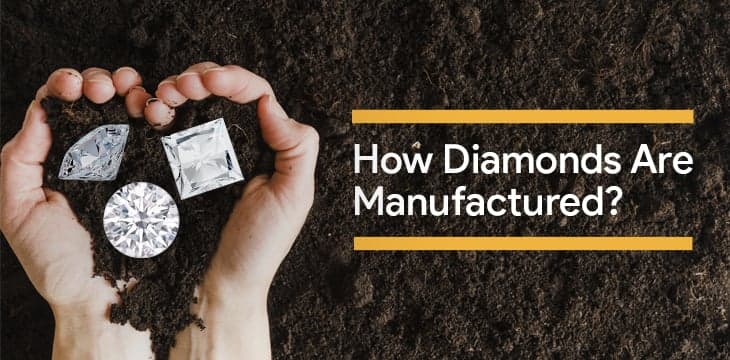

While there is a plethora of innovative ways to reach a person's heart, Diamonds are undoubtedly the most elusive, delicate, and charming. These shiny and glittery gemstones fill life in a simple engagement ring or a necklace and make it stand out as a mark of royalty and status. Technological advancement in the mineral industry laid the foundation of 'Lab-grown diamonds' or 'man-made diamonds.' They are a replica of natural diamonds and only differ based on their origin or birthplace. The real one exists deep inside the earth, and humans create the replica in a lab by replicating the necessary conditions.
Considered one of the most precious items known to man, diamonds have to travel a long, tiring journey to finally achieve their ultimate form. It is one of the most popular gemstones for precious jewellery pieces and has significant importance for industry use. Let's explore the various changes Diamonds have to undergo to beautify our ornaments.
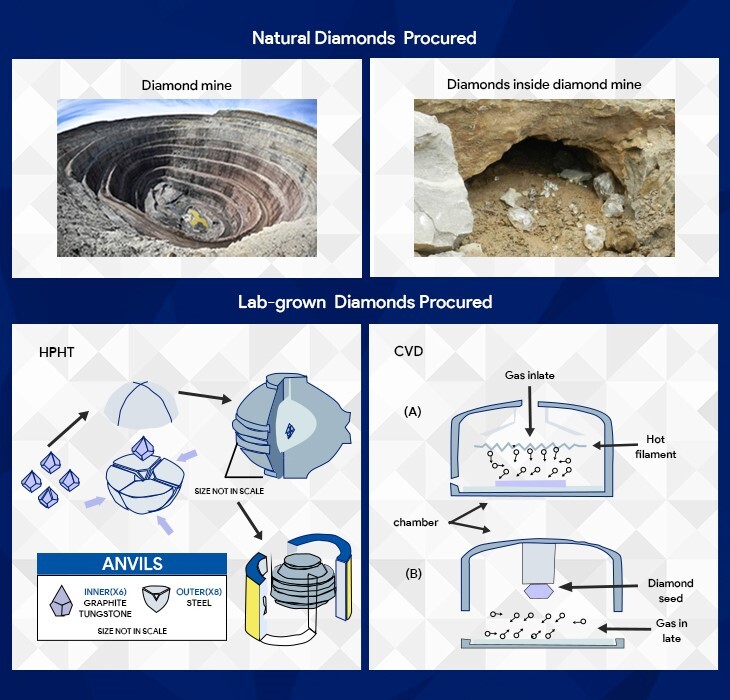
Diamonds are a solidified version of carbon elements with atoms arranged in a specific cubic structure. Dating back to nearly 3 billion years, these rough diamonds were formed due to rigorous heating and pressure on carbon crystals. They are extracted from depths 90-155 miles below the earth's surface. The volcanic disturbance pushes the minerals upwards, thus simplifying the digging process.
Found in different exclusive zones across the globe, the extraction of rough diamonds is a well-dedicated process undertaken by people having expert knowledge about the minerals. The method used for extraction is entirely different in different places.
A team of experts studies the geographics of a place to find the possibility of diamonds in the region. On getting hints of diamond existence, mining is done to dig out the precious gemstones. The next step involves sorting the rough diamonds based on their characteristic features. They are transported to the cutting and polishing for the final finesse from factories, and they reach the wholesale and retail markets for sale to the end-users.
Lab-grown diamonds possess similar physical and chemical properties as mined diamonds and can be distinguished only through specialized tests. The process involved in recreating Earth-like conditions is a complex and technical regime that requires a lot of effort. There are two prominent techniques to create synthetic diamonds, namely:
In this system, diamonds are exposed to a very high temperature of 2200 degrees Fahrenheit and high pressure of 175,000 psi using a piece of specialized equipment used for the synthesis of diamonds. The conditions are set to give the diamond a similar setup as inside the earth's surface. The changes frame the diamond structure to make it suitable for industrial purposes. The nature of the diamond selected plays an essential role in deciding the colour of the diamond. The structural changes transform some diamonds into different colours like white, yellow, greenish-yellow, blue, pink, etc.
The process uses a diamond seed, hydrocarbon gas molecule, and methane in a vacuum vessel. It involves a chain of events through which the temperature in the chamber is increased to 900 degrees through 1200 degrees. During this, the gas transforms into a highly reactive carbon-hydrogen structure. The rise in temperature affects the diamond seed and collects the diamond atoms until the entire crystal is formed.
Sorting refers to the categorization of diamonds depending on various characteristics. The main criteria for sorting are the size, colour, and quality of the diamond.
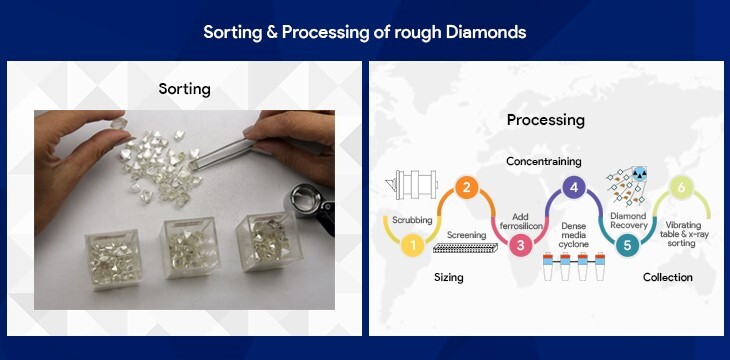
The entire process involves three important steps:
• Step 1 : For easy distribution to different clients, the diamond extractors categorize them. These categories are designed on various factors such as shape, size, weight, quality, and colour
• Step 2 :The expert diamond cutters classify the rough diamonds depending upon the criteria of their work or the requirement of their client.
• Advanced Sorting :Here, various categories of sorted diamonds are combined to form an advanced package version of the metal. The quality of sorting plays a big role in deciding the market potential of the package.
• Screening: The ore is given a perfect size via the vibrating screens. Wet screening is used for the purpose as it helps in keeping dust away from the product. A correct screening shield helps to achieve good results.
• Scrubbing: It helps to remove lumps of clay from the ore. Post scrubbing, the ore is wet screened to remove impurities of less than 1mm size. The diamonds that are smaller than this standard size hold no value in the industry.
• Concentration: In this step, the ore is put into a ferrosilicon slurry. It is then exposed to a dense media cyclone which separates waste easily. The heavy minerals collect to the bottom screen while the impurities head to the floats screen. The diamonds are obtained through the recovery process.
• Collection: The diamonds are procured in several ways like: vibrating table & x-ray sorting process.
Diamond cutting is a detailed art that requires technologically advanced tools, knowledge, and expertise. Cutting a diamond is possible using a diamond as it is the hardest mineral, and so many other metals cannot be used for the purpose.
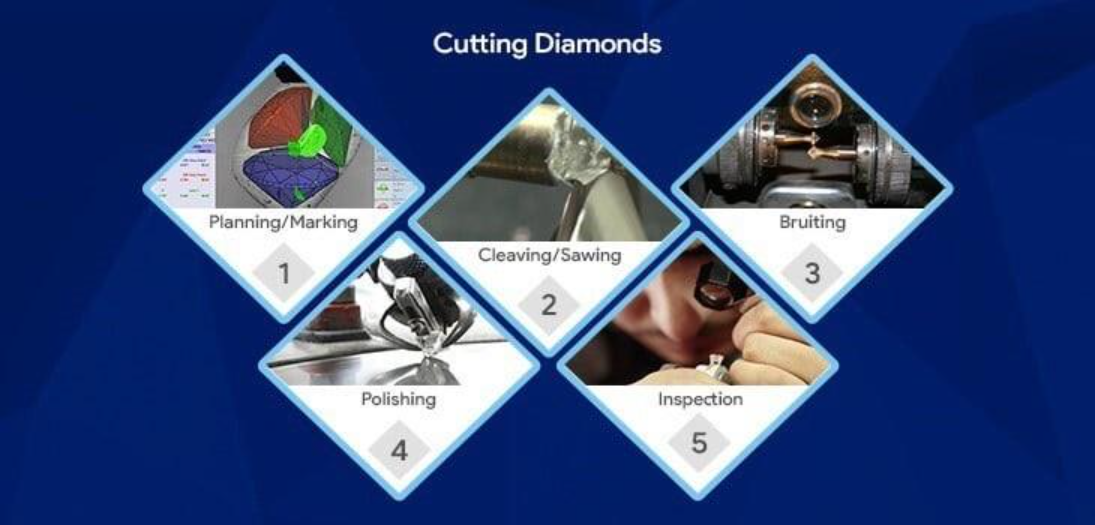 However, today, lasers are also quite prevalently used for cutting. There are five pivotal steps in cutting, and they are:
• Planning/Marking: This is the first step which requires the expertise of a person who knows about the structure & properties of diamonds. Latest technology and advanced computers are used to plan the cutting process. It helps to give a shape to the thought of the crafter on paper.
• Cleaving/Sawing: The second step is cleaving. In this step, side pieces of diamond are cut to form the rough shape of the diamond as planned.
• Bruiting: Polishing helps to give the final touch to shape and glittery shining structure to the diamond. This adds shine to the cuts. The process enhances the value of a diamond significantly.
• Inspection: This is the final step in the cutting process. In this, an expert scrutinizes the cuts and worth of the diamonds.
Once the diamond is cut & polished, it passes through a quality check. It is certified by standard laboratories like GIA, IGI, HRD, etc., to determine the value of the diamond. The four most important factors determining a diamond's value are its colour, clarity, weight, and cut. Grading helps to assess the cost and value of a diamond. In this regard, GIA's 4Cs form the basis of distinction. They help to facilitate universal communication of diamond quality and allows customers to know what they are purchasing.
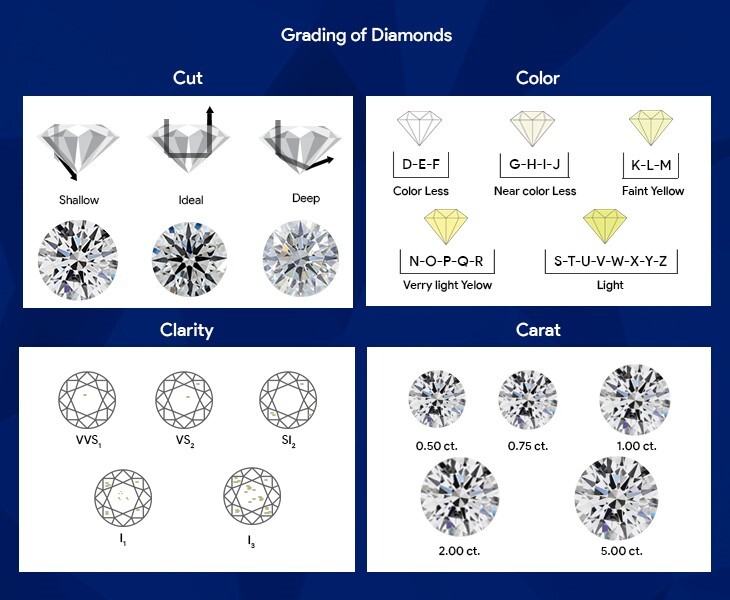
The four Cs are:
• Cut: A diamond cut shows how well it reflects the light and sparkles. It is achieved by perfect, proportionate cutting and polishing of the diamond. The GIA calculator ascertains the facet proportions affecting the face-up appearance of the diamond to decide the quality of its cut. The cuts help the diamond to create various visual fantasies like scintillation.
• Colour: The colour of a diamond helps to choose the perfect piece. A diamond with no hue is considered to have white color.
• Clarity: Clarity shows the absence of internal features called inclusions and external features called blemishes on a diamond. During the evaluation, the expert studies the characteristics of these features and manages to decide the purity of a particular stone.
• Carat: It measures the weight of a diamond and plays an important role in determining price. Every carat is portioned into 100 points, whereas a metric carat is equivalent to 200 milligrams. The rise in diamond carat causes a surge in its cost.
The diamond certificate is an important document given by reputed 3rd party labs such as GIA, IGI, HRD, etc., when purchasing a diamond. The certification assures the purchaser of the characteristic features of the diamond purchased by them. It mentions the colour, clarity, and size of the stone to get genuine products in hand.
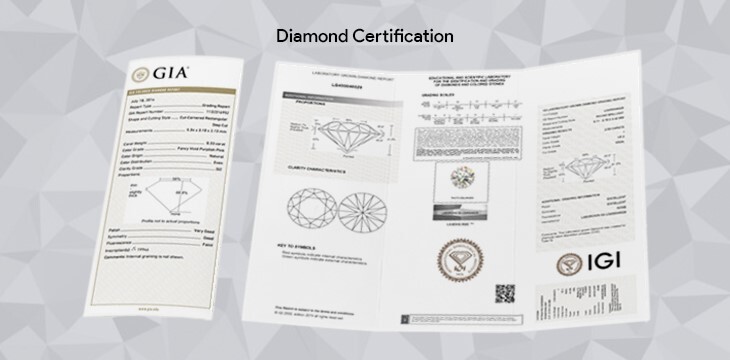
The buyer must review the lab certification properly. They should purchase a diamond from a seller who provides them with a certificate from a trustworthy grading firm.
We know that diamonds are known for the element of uniqueness, finesse, and value they possess within themselves. These dazzling stones have a unique space in the jewellery industry and the market space. The firms complete the Processing, polishing, and cutting of diamonds and then transport them to the retail market for sale. The entire journey of a diamond is quite lengthy and complicated; however, it is worth the pain as a glittering diamond, when ready for use, is a delight for the viewer.